


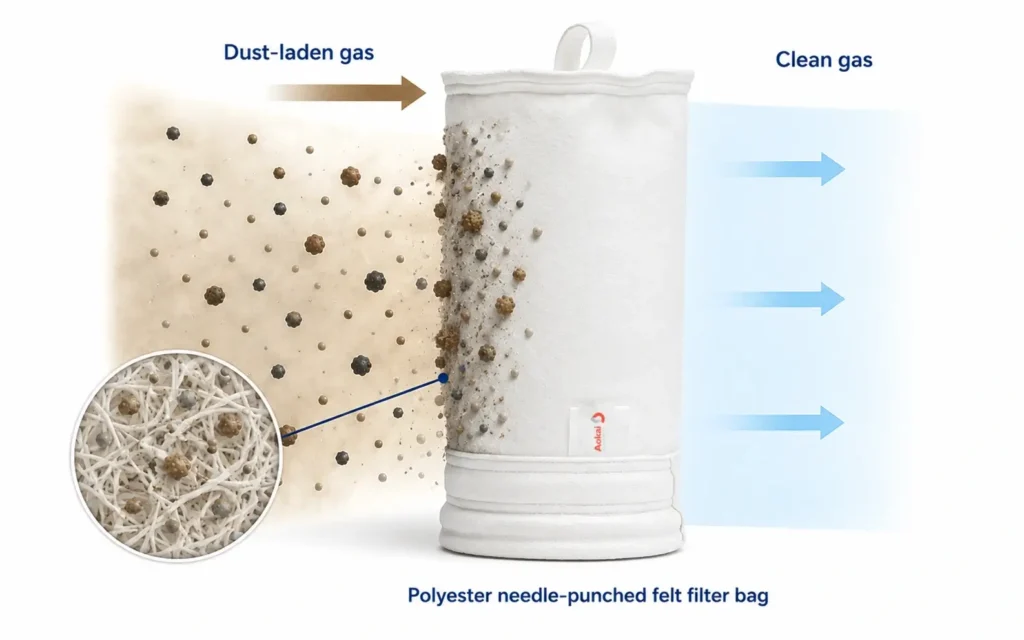
Needle felt filter bags are a subset of non woven filter bags, Unlike standard linear woven or simple meltblown structures, needle felt filter bags are made by mechanically punching thousands of barbed needles through cross-lapped fiber webs. This interlocks individual fibers around a heavy woven base scrim, creating a unified non woven matrix with high physical integrity and isotropic strength.
- Reinforced core scrim prevents elongation or bag sagging under heavy dust cake weight.
- Randomly distributed fiber pathways provide a complex 3D filtration matrix.
Needle Felt vs. Woven Filter Bags
Needle felt and woven filter bags use different fabric structures. Needle felt is made by mechanically interlocking randomly arranged fibers around a supporting scrim. Woven filter media is produced by interlacing warp and weft yarns in a defined weave pattern.
Needle felt is commonly used in pulse-jet baghouses because its three-dimensional structure provides good fine-dust capture, airflow and cleaning performance. Woven media is often selected for shaker or reverse-air baghouses and certain high-temperature applications, especially woven fiberglass filter bags.
| Feature | Needle Felt Filter Bags | Woven Filter Bags |
|---|---|---|
| Structure | Random fibers needle-punched around a scrim | Interlaced warp and weft yarns |
| Filtration | Depth filtration or surface filtration with an ePTFE membrane | Mainly surface filtration through the woven structure |
| Fine-Dust Capture | Generally better for fine industrial dust | Depends on weave density and surface treatment |
| Typical Cleaning Method | Pulse-jet cleaning | Shaker or reverse-air cleaning |
| Common Materials | Polyester, acrylic, aramid, PPS, P84 and PTFE | Fiberglass and other woven fibers |
| Main Advantage | High filtration efficiency and flexible material selection | Strong dimensional stability and suitability for selected high-temperature systems |
Needle Felt Filter Bags Technical Data Center
| Felt Polymer Type | Density Weights | Max Continuous Temp | Acid Resistance | Alkali Resistance | Optimal Environments |
|---|---|---|---|---|---|
| Polyester(PES) Needle Felt | 500 - 600 g/m² | 130℃ (266°F) | Good | Good | Cement Plants, Steel Milling, Timber Drying, Basic Flue Dusts |
| Nomex(Aramid) Needle Felt | 500 - 550 g/m² | 204℃ (400°F) | Moderate | Excellent | Asphalt Mixing plants, Gypsum Drying, High Temperature Kiln Outlets |
| Ryton (PPS) Needle Felt | 500 - 550 g/m² | 190℃ (374°F) | Excellent | Excellent | Coal-Fired Utility Boilers, Industrial Trash Incineration |
| PTFE(Teflon) Needle Felt | 500 - 750 g/m² | 260℃ (500°F) | Excellent | Excellent | Corrosive Chemical Gasses, Hazardous Solid Waste Smelting |



Needle Felt Surface Finishing Treatments
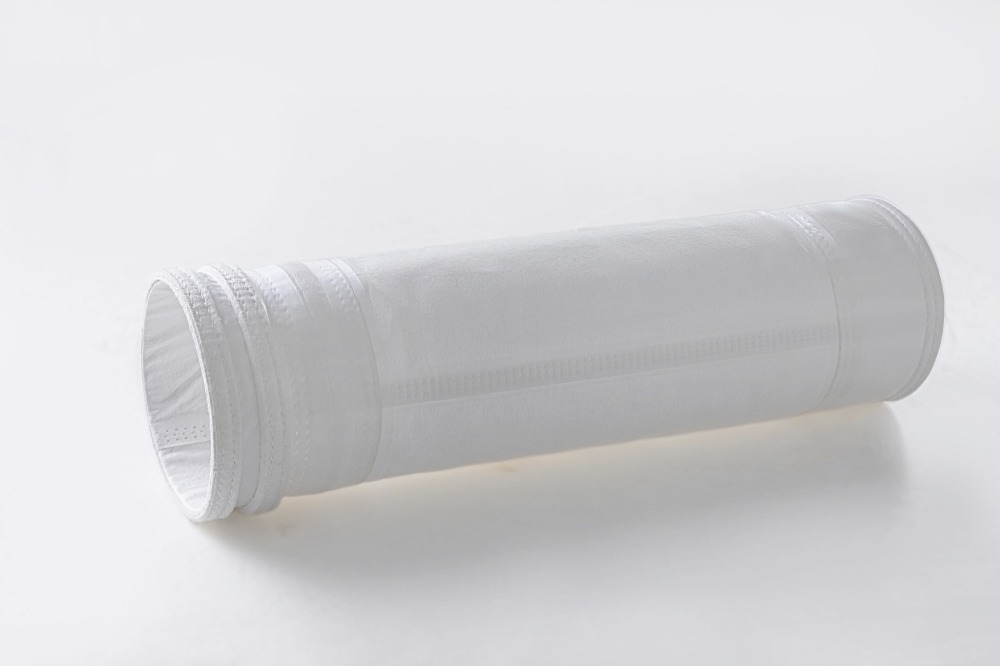
Raw non woven needle felt requires strategic post-manufacturing finishes. These processes seal microfibers, alter chemical affinity, and allow dust cakes to easily slide off.
Visualized Microscopic Matrix
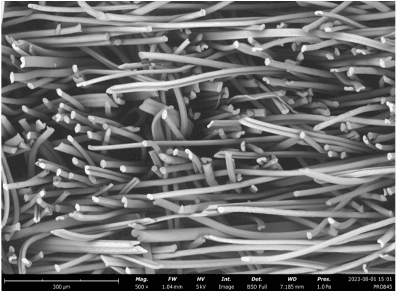
Our structural configuration captures fine particulates down to PM2.5 within the thick, multi-layered 3D needle felt fibers.
Frequently Asked Questions
Got questions about our needle felt non-woven filtration technologies? Find detailed technical explanations below.
Needle felt filter bags are engineered through a mechanical needle-punching process that creates a highly porous, three-dimensional depth-filtration matrix. Unlike surface-only woven filters, needle felt allows dust to be trapped throughout the entire depth of the media, leading to lower differential operating pressure, higher dust retention.
Felt weight directly influences durability, filtration efficiency, and pressure drop. 500 g/m² is the industrial standard for most general dust collectors. However, 550 g/m² to 600 g/m² options are recommended for high-volume or abrasive dust environments to provide extra mechanical resistance and extend intervals between bag changes.
Absolutely. We custom manufacture to your precise mechanical blueprints. This includes adjusting custom lengths, tailoring precise filter sleeve diameters, and providing heavy-duty collar styles (e.g., spring snap-bands, steel-ring collars, or silicone rubber cuffs) to ensure a perfectly seamless, dust-free fit inside your existing filter cages
GET IN TOUCH NOW
Request a Custom Specs Needle Felt Quote
Need customized lengths, special steel collar rings, or PTFE-membrane needle felt filter bags? Our application engineers will calculate details and deliver the perfect fitment drawings.
*All information will be kept confidential.