


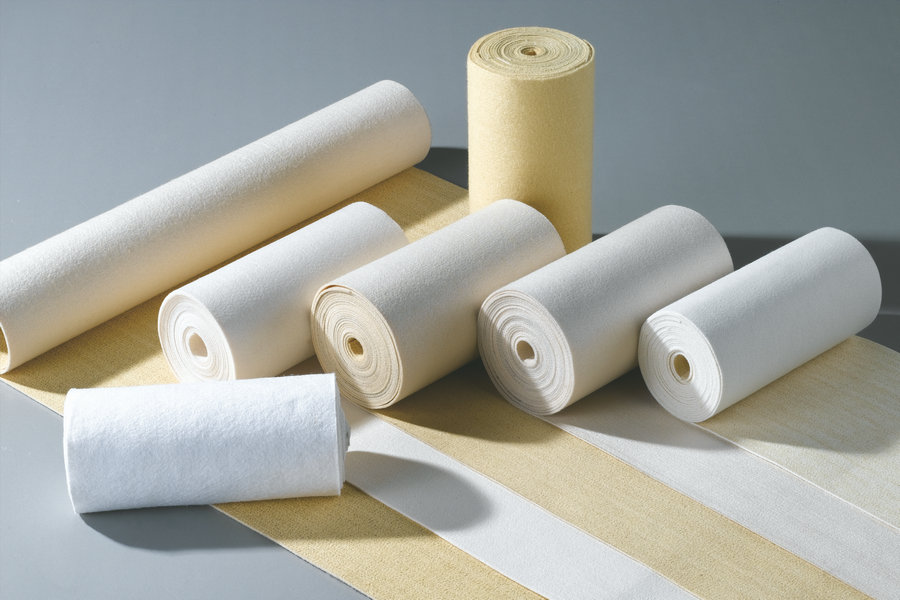
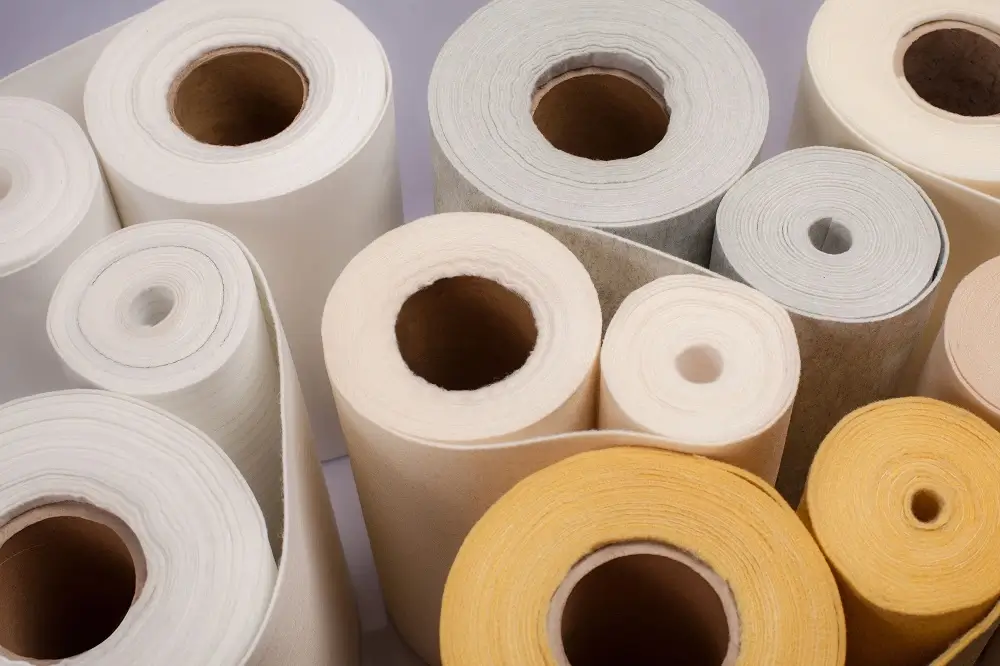
Homopolymer acrylic needle felt for baghouses exposed to moisture, condensation and mildly acidic gas.
Aokai manufactures acrylic filter cloth for industrial dust collection and finished filter bag production. We customize media weight, thickness, air permeability, surface finish, roll size and final bag construction to match your operating conditions.
What Is Acrylic needle felt?
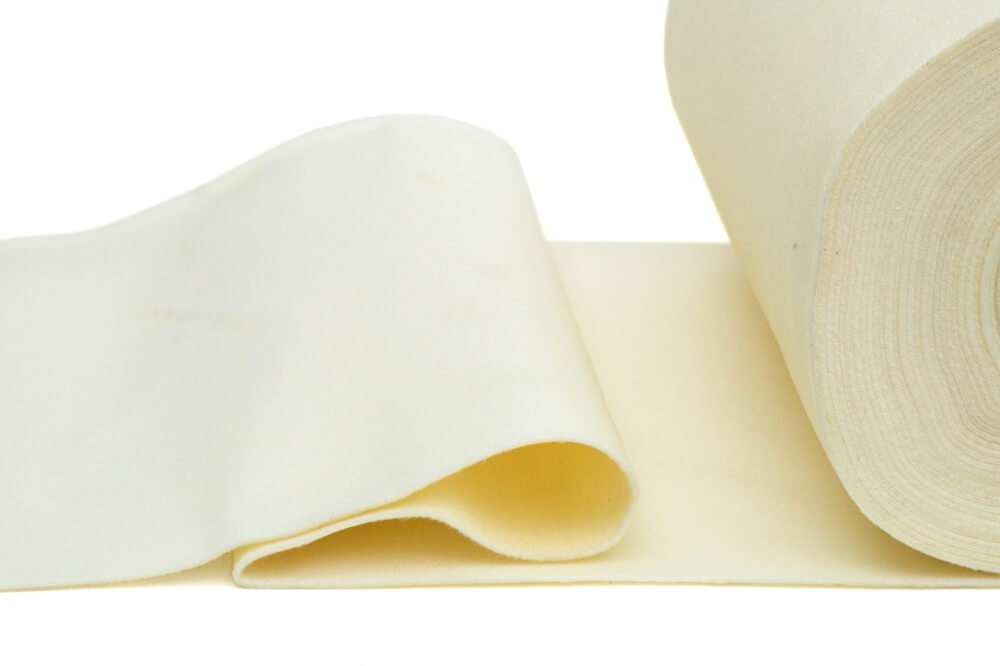
Acrylic filter cloth usually refers to homopolymer acrylic needle felt made from polyacrylonitrile, also called PAN.Acrylic filter cloth is a nonwoven filter medium made by needle-punching acrylic fibers around a supporting scrim. The three-dimensional fiber structure captures dust while allowing cleaned gas to pass through the media.
Acrylic needle felt can be heat-set and finished to improve dimensional stability, dust release, moisture resistance or fine-particle collection.
Acrylic needle felt is commonly converted into pulse-jet, reverse-air or shaker filter bags. It can also be supplied in rolls for filter bag manufacturers and industrial maintenance teams.
Acrylic Filter Cloth Technical Specifications
| ITEM | PA155 | PAT155 |
|---|---|---|
| Material | 100% Homopolymer Acrylic Needle Felt | Homopolymer Acrylic Needle Felt |
| Working temperature (°C) | 130 | 130 |
| Peak temperature (°C) | 150 | 150 |
| Weight (g/m2) | 550±5% | 550±5% |
| Thickness (mm) | 3.0±10% | 2.4±10% |
| Air permenability (m3/m2/min@200Pa) | 14±20% | 16±20% |
| Tensile strength / warp(N/5cm) | ≥800 | ≥900 |
| Tensile strength / weft(N/5cm) | ≥800 | ≥1200 |
| Tensile elongation /warp(%) | ≤35 | ≤35 |
| Tensile elongation / weft(%) | ≤50 | ≤50 |
| 24-hour heat shrink / warp(%) | ≤1.5 | ≤1.5 |
| 24-hour heat shrink / weft(%) | ≤1.0 | ≤1.0 |
| Hydrolysis Resistance | Excellent | Excellent |
| Acid Resistance | Good | Good |
| Alkali Resistance | Moderate | Moderate |
| Available Construction | Custom | Custom |
*PA155, PAT155 are Aokai internal Acrylic filter bag model codes. Each model is developed with different fiber blend ratios, scrim constructions, surface finishes, and optional membrane or functional treatments to suit different filtration conditions.
- Aokai’s standard acrylic needle felt is available in widths up to 2,250 mm.
- Aokai can custom acrylic needle felt to match the required filtration performance and manufacturing process.
Typical Applications
From Acrylic Fiber to Finished Filter Media
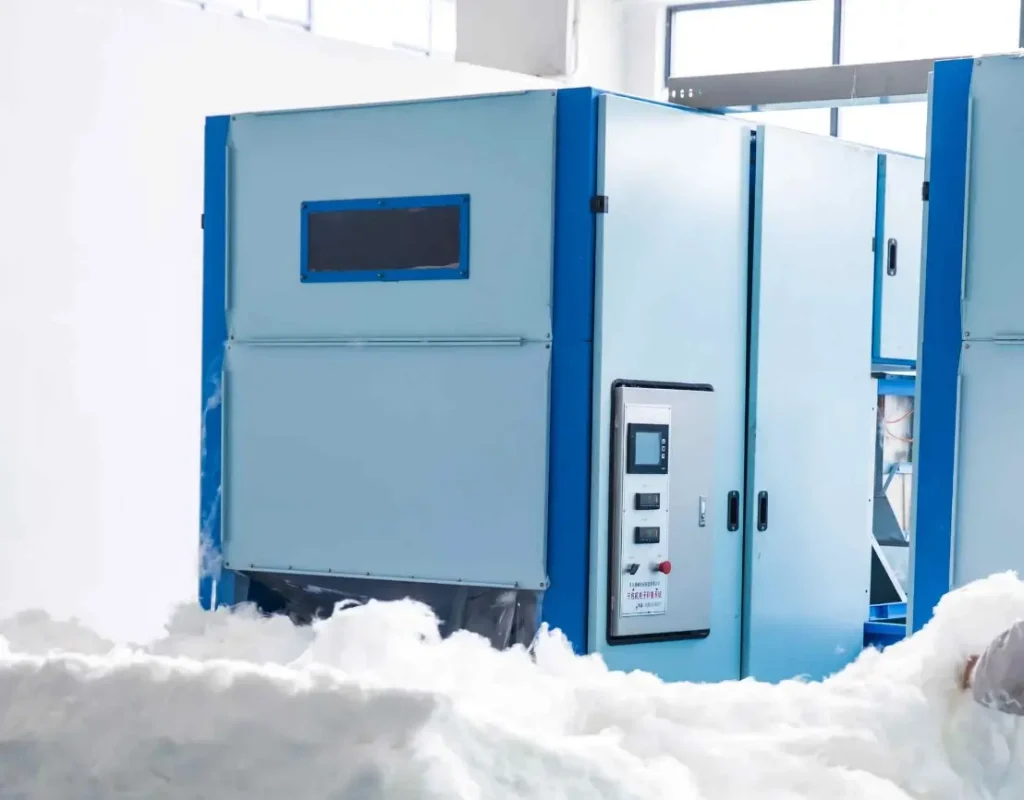
Automated Fiber Opening and Blending
Fully enclosed automatic feeding ensures precise and consistent fiber blending. This process helps reduce premature filter bag failure by up to 60%.

Carding Section
A double-cylinder carding machine with imported card clothing provides thorough fiber opening with minimal fiber damage and stable air permeability. This process increases filter media tensile strength by 20%.
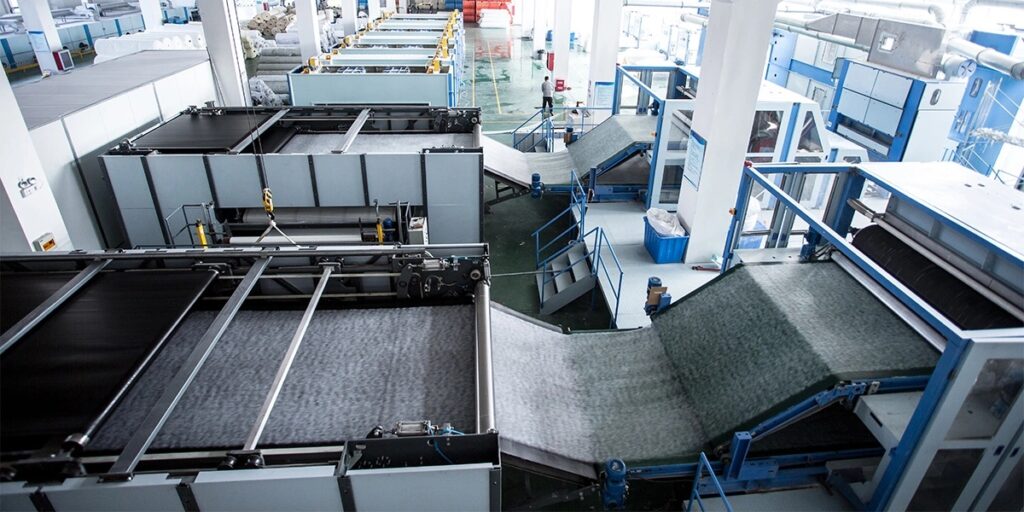
Web-Laying System
The German AUTEFA five-axis cross-lapper with online weight compensation ensures a uniform fiber web and consistent basis weight. This process extends average filter bag service life by 15%.

High-Frequency Needle Punching
Eight imported high-frequency needle-punching units are equipped with original German Groz-Beckert needles. The resulting filter media achieves an ultrafine dust capture efficiency of over 99.99%.*
HELP & SUPPORT
Acrylic Filter Cloth FAQ
Acrylic filter cloth is used to make industrial dust collector filter bags for low- and medium-temperature gas streams. It is commonly selected when high humidity, condensation or mildly acidic gas may cause hydrolysis damage to standard polyester media. Typical uses include selected cement, drying, chemical, metal-processing and post-treatment applications.
The acrylic filter cloth described on this page is nonwoven needle felt. Acrylic fibers are mechanically entangled around a supporting scrim to create a porous, three-dimensional filtration structure. Woven acrylic fabrics also exist, so buyers should specify whether they need needle felt, woven cloth, roll media or finished filter bags.
Homopolymer acrylic needle felt is an industrial filter medium made from polyacrylonitrile-based acrylic fiber. It is valued for its resistance to hydrolysis and selected acidic conditions. It is often used as an alternative to polyester when moisture or condensation is shortening filter-bag life, provided the temperature remains within the approved range.
Aokai’s PA155 and PAT155 acrylic media are designed for continuous operation up to 130°C, with short peak exposure up to 150°C. Actual limits depend on exposure time, gas chemistry, moisture, oxygen and the selected finish. Frequent temperature excursions require an engineering review and may call for PPS or another higher-temperature material.
Acrylic is generally the better choice when hydrolysis, humidity or mildly acidic gas is causing polyester to degrade. Polyester remains more economical for dry, low-temperature dust collection. Acrylic is not automatically better for high temperature or severe chemical exposure, so the selection must reflect the complete operating conditions.
Yes. A suitable ePTFE membrane can be laminated to acrylic needle felt to create a surface-filtration layer. This option can improve fine-particle capture and dust release. Membrane selection must account for particle size, dust abrasiveness, cleaning method, gas chemistry and the required emission level.
Yes. Aokai can customize media weight, thickness, air permeability, roll dimensions, scrim construction and finishing. Available services also include cut media and finished acrylic filter bags with custom dimensions, top and bottom designs, seams and reinforcement. Send your current specification, sample or operating data for review.
Provide the required roll dimensions and quantity, media weight, thickness, air permeability, continuous and peak temperature, dust type, moisture level, gas chemistry, cleaning method, finish and destination. If some details are unknown, send an existing media sample or filter bag drawing so Aokai can identify a practical starting specification.
Contact us
*All information will be kept confidential.