


Aokai manufactures ultra-low emission filter bags for industrial baghouses operating under increasingly stringent particulate emission requirements.
Our solutions combine application-matched filter media, ePTFE membrane surface filtration, controlled bag construction and accurate bag-to-cage fit. They are designed for projects targeting outlet dust concentrations below 10 mg/Nm³ and, where the complete baghouse system allows, below 5 mg/Nm³.
Available substrates include polyester, acrylic, aramid, PPS, P84, fiberglass and PTFE. Every filter bag can be customized to match the temperature, gas chemistry, dust properties, cleaning method and dimensions of the existing dust collector.
Designed for: Fine and submicron industrial dust
Emission targets: ≤10 mg/Nm³ and ≤5 mg/Nm³
Cleaning systems: Pulse jet, reverse air and mechanical shaker
Custom options: Media, membrane, dimensions, top, bottom, thread and cage fit
What Are Ultra-Low Emission Filter Bag?
Ultra-low emission filter bags are industrial dust collector bags developed for baghouses that need to maintain a very low outlet particulate concentration.
For most projects, “ultra-low emission” refers to a target below 10 mg/Nm³. More demanding plants may require outlet emissions below 5 mg/Nm³.
Compared with conventional needle felt, an ultra-low emission filter bag normally uses a high-efficiency filtration surface, such as an ePTFE membrane filter bags, to prevent fine particles from penetrating deeply into the filter media.
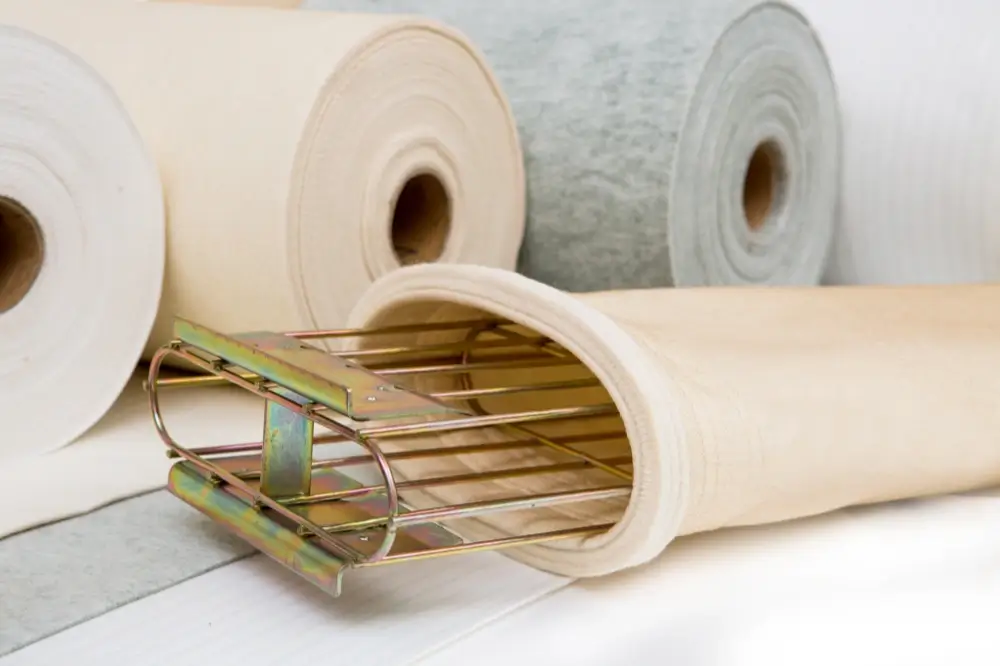
How Aokai Supports Ultra-Low Emission Performance
1. High-Efficiency ePTFE Membrane
Aokai can laminate an ePTFE membrane onto different needle-felt or woven substrates.
The microporous membrane provides surface filtration and helps capture fine particles, including dust that would otherwise penetrate conventional felt. Because most of the dust remains on the surface, the filter cake is generally easier to remove during cleaning.
Potential benefits include:
- Improved fine-particle capture
- Lower particle penetration into the felt
- More consistent emissions after bag replacement
- Easier dust-cake release
- Reduced risk of deep media blinding
- More stable operating differential pressure
- Better recovery of valuable process powders
The membrane grade must be selected according to the dust particle size, required permeability, cleaning intensity and mechanical operating conditions.
2.Controlled Filter Bag Construction
Low-emission performance depends on more than the flat filter media.
Possible dust leakage paths include stitching holes, incomplete seams, damaged bottoms, incorrect snap-band dimensions and poor sealing between the bag and tube sheet.
Aokai controls the filter bag construction according to the application, including:
- Consistent seam alignment and stitch density
- Sewing thread matched to the filter media
- Reinforced top and bottom constructions
- Accurate snap-band dimensions
- Secure tube-sheet sealing
- Correct bag diameter and cage clearance
- Reinforcement in high-wear areas
- Dimensional inspection before shipment
Additional leakage-control measures can be evaluated for projects with particularly strict emission requirements.
3.Correct Bag-to-Cage Fit
A filter bag that is too tight may be difficult to install and may experience excessive abrasion. A bag that is too loose can fold, rub against the cage and clean unevenly.
For replacement projects, Aokai can match the filter bag and cage using original drawings, an existing bag sample or field measurements.
The evaluation includes:
- Filter bag diameter and length
- Cage diameter and wire arrangement
- Venturi dimensions
- Tube-sheet hole diameter
- Snap-band groove and thickness
- Bag bottom clearance
- Cage joint design for long filter bags
Ultra-Low Emission Filter Bag Options

Aramid Filter Bags
Continuous:204°C (399°F)
Peak Max:240°C (464°F)
Cement kilns, hot mix asphalt manufacturing, metallurgical dust collector, and chemical production furnaces.

PTFE Baghouse Filter Bags
Continuous:240°C (464°F)
Peak Max:260°C (500F)
Chemical incineration plants, waste-to-energy facilities, coal power generation, and highly volatile acid gas flues.

PPS Filter Bags
Continuous:160°C (320°F)
Peak Max:190°C (374F)
Coal-fired industrial power plant flues, high-moisture biomass boilers, and dry waste flue gas purification.
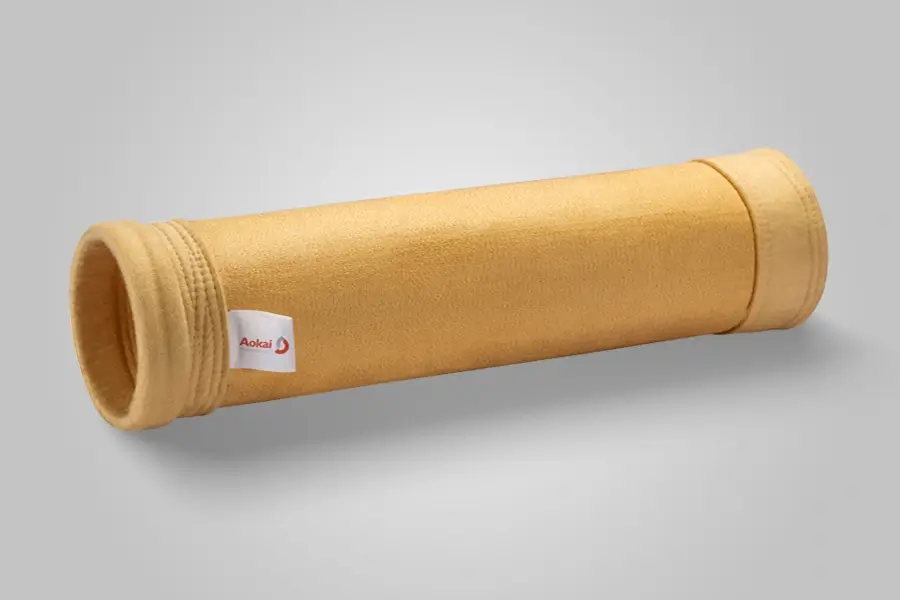
P84 Filter Bags
Continuous:240°C (464°F)
Peak Max:260°C (500F)
Waste incinerators, cement production kilns, smelting blast furnaces, and asphalt batching exhaust systems.

Nomex Filter Bags
Continuous:204°C (399°F)
Peak Max:240°C (464°F)
Iron & steel smelting blast furnaces, calcium carbide furnaces, rotary cement kilns, and silicon power structures.

GlassFiber Filter Bags
Continuous:260°C (500°F)
Peak Max:280°C (536°F)
High-temperature dry flue gas systems, cement production pre-heaters, and non-ferrous metal smelting baghouses.
Technical Specifications of Ultra-Low Emission Filter Bag
| Filter media | Typical continuous temperature | Main characteristics |
|---|---|---|
| Polyester + ePTFE membrane | Up to 130°C | Cost-effective, good abrasion resistance and suitable for dry conditions |
| Acrylic + ePTFE membrane | Up to 130°C | Better hydrolysis and mild-acid resistance than standard polyester |
| Aramid + ePTFE membrane | Up to 204°C | Good heat resistance, strength and dimensional stability |
| PPS + ePTFE membrane | Up to 160°C | Excellent hydrolysis resistance and good acid and alkali resistance |
| P84 + ePTFE membrane | Up to 240°C | High-temperature capability and good performance with fine dust |
| Fiberglass + ePTFE membrane | Up to 260°C | High-temperature resistance and excellent dimensional stability |
| PTFE felt + ePTFE membrane | Up to 260°C | Broad chemical resistance and high-temperature stability |
The specifications above are typical reference values. Final filter media and bag construction are selected according to the operating temperature, gas composition, dust properties, cleaning method and required outlet emission level.