


Sektör İçgörüleri
Let Aokai Provide a Detailed Introduction to Industrial Dust Collector Filter Bags
Industrial Dust Collector Filter Bags: A Complete Guide
Industrial dust collector filter bags are one of the most critical components in a baghouse dust collection system. They are responsible for capturing dust from industrial exhaust gases, protecting downstream equipment, helping factories meet emission standards, and maintaining stable operation of production systems.
What Are Industrial Dust Collector Filter Bags?
Industrial dust collector filter bags are filtering elements installed inside baghouse dust collectors. When dust-laden gas passes through the filter bags, dust particles are trapped on the surface or within the filter media, while the cleaned air passes through and is discharged from the collector.
As dust accumulates, the dust collector periodically removes it from the filter bag surface through methods such as pulse jet cleaning, reverse air cleaning, or mechanical shaking.

Main Types of Industrial Dust Collector Filter Bags
Industrial dust collector filter bags are typically classified based on cleaning method and installation structure.
1. Pulse Jet Filter Bags
These filter bags usually require a filter cage inside and are cleaned using compressed air pulses.
2. Reverse Air Filter Bags
Reverse air filter bags are cleaned by reversing airflow and are commonly used in compartmentalized large-scale baghouse systems.
These bags are generally longer and suitable for large industrial systems that require gentler cleaning methods.
3. Mechanical Shaker Filter Bags
Mechanical shaker filter bags rely on mechanical devices to vibrate the bags and shake off accumulated dust from the surface.
This structure is less common in newer dust collection projects but can still be found in older systems.
How to Choose the Right Filter Bag Material?
Filter media is one of the most important factors in selecting dust collector filter bags. Selection should not be based solely on temperature resistance; it must also consider dust characteristics, humidity, gas chemical composition, cleaning method, and operating environment.
Below are common industrial filter bag materials:
| Filtre Malzemesi | Typical Continuous Temperature | Key Advantages | Common Applications |
|---|---|---|---|
| Polyester | Below approx. 130°C | Cost-effective, good abrasion resistance | Cement, mining, woodworking, grain processing |
| Akrilik | Below approx. 140°C | Better hydrolysis resistance than polyester | Humid or chemically complex environments |
| Aramid | Below approx. 200°C | High temperature resistance, good mechanical strength | Asphalt, steel, high-temperature gas filtration |
| PPS | Below approx. 160°C | Excellent acid and chemical resistance | Coal-fired boilers, waste incineration, chemical industry |
| P84 | Below approx. 240°C | Unique fiber structure, excellent filtration performance | Cement kilns, incineration, fine high-temperature dust |
| PTFE | Below approx. 240°C | Outstanding corrosion and moisture resistance | Chemical industry, highly corrosive gas environments |
| Fiberglas | Below approx. 260°C | High temperature resistance, dimensional stability | Cement kilns, power plants, metallurgy |
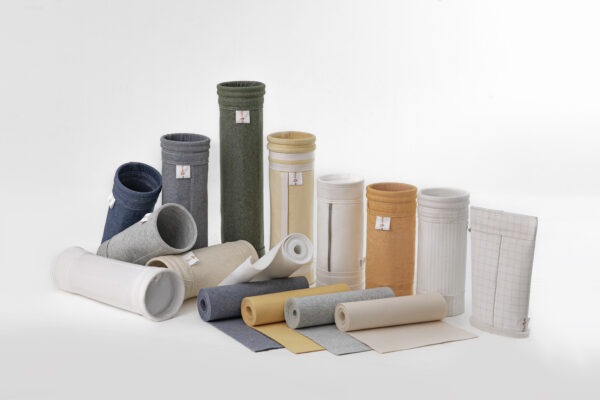
Actual temperature resistance can be affected by fiber composition, finishing processes, membrane structure, gas composition, dust characteristics, and operating conditions. Therefore, filter bags should not be selected based on temperature alone.
Key Factors to Consider When Selecting Filter Bags
1. Operating Temperature
Both normal operating temperature and peak temperature must be considered.
Some filter bags can operate stably under normal conditions, but frequent temperature fluctuations or sudden spikes may cause rapid aging, shrinkage, or damage.
2. Humidity and Dew Point
Moisture is one of the main causes of filter bag problems.
When gas temperature drops below the dew point, condensation occurs inside the dust collector. Dust mixed with moisture can adhere to the filter bag surface, leading to blinding, caking, and cleaning difficulties.
For humid or oily dust conditions, consider water- and oil-repellent treatments, PTFE membrane filter bags, or materials with better moisture resistance.
3. Gas Chemical Composition
Acidic gases, alkaline dust, sulfides, nitrogen oxides, chlorides, and solvent vapors all affect filter bag lifespan.
For example:
- PPS filter bags are suitable for environments requiring strong acid resistance.
- PTFE filter bags are ideal for highly corrosive gas conditions.
- Aramid filter bags are not suitable for strong acid or high humidity environments.
- Polyester filter bags may experience hydrolysis under high temperature and high humidity conditions.
For complex conditions, it is recommended to provide gas composition and dust analysis data before selection.
4. Dust Characteristics
Dust properties directly influence the choice of filter material, weight, surface treatment, and bag structure.
For highly abrasive dust, consider thicker filter media, abrasion-resistant base fabrics, or wear-resistant surface treatments.
For ultra-fine dust, PTFE membrane filter bags can improve surface filtration efficiency and reduce dust penetration into the media.
Sonuç
Industrial dust collector filter bags directly affect dust collection efficiency, emission stability, and production continuity.
Proper selection and maintenance can help achieve longer filter bag life, lower operating costs, more stable emissions, and more reliable system performance. Aokai has over 20 years of experience in industrial dust collection and has served more than 40 countries and regions worldwide. We have extensive experience handling various environments and dust collector systems. Feel free to contact Aokai anytime—we are happy to assist you!
SSS
What is the most commonly used filter bag material?
Polyester is one of the most commonly used materials due to its cost-effectiveness and suitability for many medium- and low-temperature dry dust applications. However, it is not suitable for all environments.
How long do industrial dust collector filter bags last?
Filter bag lifespan depends on actual operating conditions. Under stable temperature, humidity, airflow, and cleaning conditions, filter bags may last several years. However, in high-temperature, highly abrasive, high-humidity, or corrosive environments, lifespan will be significantly reduced.
Are PTFE membrane filter bags worth the additional cost?
For ultra-fine dust, sticky dust, high emission requirements, or applications aiming to reduce pressure drop, PTFE membrane filter bags typically offer better long-term performance and can help reduce maintenance costs.
Can damaged filter cages cause filter bag failure?
Yes. Rusted, bent, broken wires, sharp weld points, or rough surfaces on cages can damage filter bags and cause dust leakage.
What information is needed when selecting replacement filter bags?
It is recommended to provide filter bag diameter, length, material, operating temperature, dust type, gas composition, humidity, cleaning method, airflow, and any failure symptoms of existing filter bags.
