


Industry Insights
Scientific Matching of Needle Felt Filter Bags and Cages: The Key to Extending Baghouse Lifespan
With the tightening of environmental standards, industrial baghouses are evolving toward large-scale and long-bag configurations. However, the increased length of filter bags brings new challenges—most notably, the risk of “bag-to-bag” collisions at the bottom ends.

To address this issue, it is crucial to recognize that the fitting precision between needle felt filter bags and their cages, as well as the specific installation details, are vital. Specifically, the manufacturing quality of the cages and high-precision installation techniques are the cornerstones of ensuring long-term, stable operation of any dust collection system.
1. Matching Needle Felt Filter Bags with Cages: Strict Control of Tube Sheet Tolerances
In most pulse-jet baghouse designs, the core of the seal lies in the interface between the snap ring of the filter bag head and the tube sheet (cell plate). To ensure that the performance of your needle felt filter bags is fully realized, pay close attention to the following three points:
- Consistency of Tube Sheet Hole Diameters: The diameter of the tube sheet holes must be strictly controlled within specified tolerances. Deviations can lead to sealing failure or damage to the needle felt filter bags due to excessive force during installation.
- Deburring: The edges of the tube sheet holes must be smooth and free of burrs to prevent scratching the filter media during installation or the cleaning cycle.
- Dimensional Fit Tolerances: The fit between the bag and the cage directly impacts cleaning efficiency. The recommended ratio varies significantly depending on the material:
A. Synthetic Fiber Needle Felt Filter Bags: Moderate “Loose Fit”
For most synthetic fiber needle felt filter bags (such as Polyester, Aramid, or PTFE felts), a loose fit is recommended.
- Fit Recommendation: For a filter bag with Φ120mm, a cage with Φ115mm should be used.
- Length Margin: The filter bag should be 15~ 30mm longer than the cage.
- Objective: This allows the needle felt filter bag to achieve sufficient amplitude during pulse-jet cleaning, effectively dislodging dust cakes and preventing “bag blinding.”
B. Fiberglass Filter Bags: Strict “Tight Fit”
While fiberglass is highly heat-resistant, its flex-resistance is relatively low. Unlike standard needle felt filter bags, fiberglass media cannot withstand high-amplitude movement. Therefore, a tight fit is mandatory.
- Fit Recommendation: A Φ120mm fiberglass bag must be matched with a Φ120mm cage, with the lengths being identical.
- Objective: This minimizes the vibration amplitude during cleaning, preventing fiber breakage caused by frequent flexing.
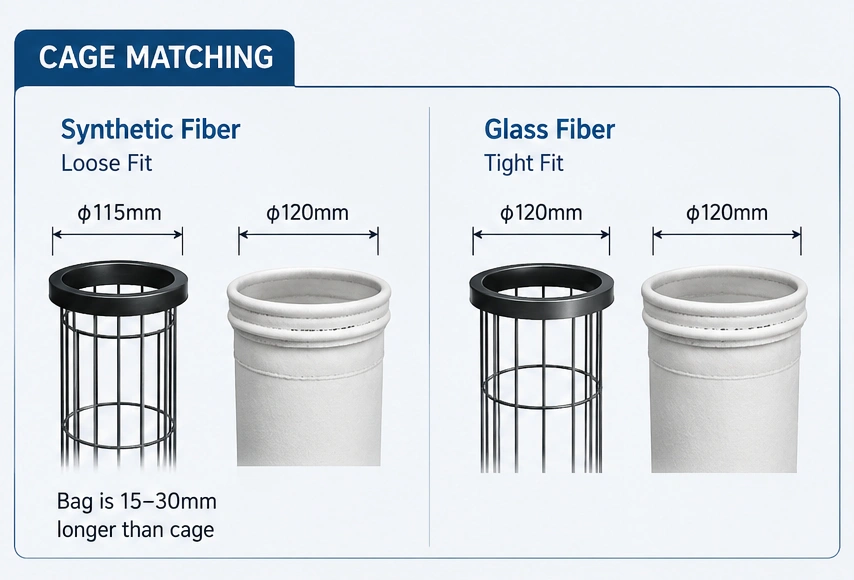
Dimensional Fit Tolerances
2. “Special Treatment” for Membrane Filter Bags
Membrane filter bags are widely utilized for their exceptional near-zero emission efficiency. However, the ePTFE membrane on the surface is fragile; even minor mishaps can lead to membrane rupture.
When installing membrane filter bags, professional protective sleeves must be used. These sleeves effectively isolate the bag from friction against the tube sheet edges. Hard pulling or pushing is strictly prohibited to prevent physical damage to the membrane filter bag surface during the installation phase, which would otherwise compromise filtration accuracy and cleaning performance.
Summary
“Details determine success.” At Aoke, our engineers have accumulated 22 years of industry experience, and we understand that the stable operation of long-bag dust collectors depends on every installation detail. By precisely controlling tube sheet tolerances, standardizing the use of protective sleeves, and applying scientific dimensional ratios, you can significantly reduce maintenance costs and improve efficiency—whether you use conventional needle felt filter bags or high-performance membrane filter bags.
Are you facing issues like “bag blinding” or abnormal bag breakage in your dust collector maintenance? Contact our technical experts today for a customized solution.
